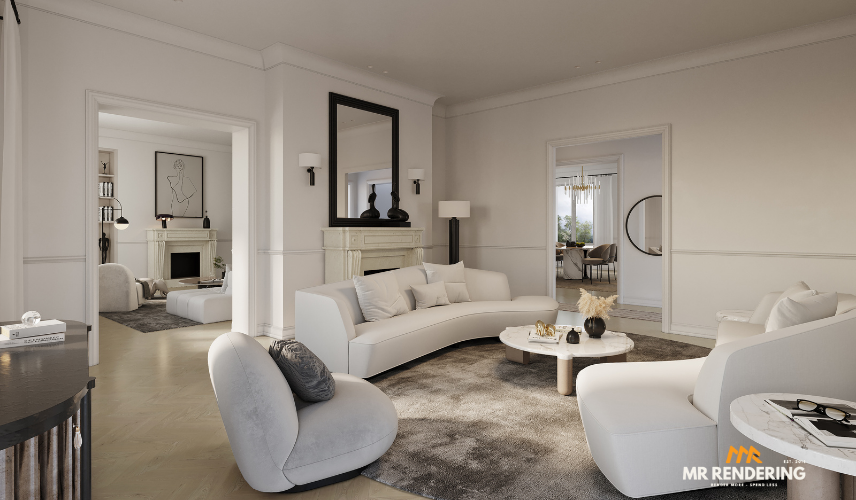
In interior concept presentations, first impressions often determine a client’s level of trust and how quickly they make decisions. For many projects, the living room is the first space clients look at and the one they rely on to judge the aesthetic taste, stylistic fit, and overall “credibility” of the entire design proposal. That’s why a well-crafted living room 3D rendering can significantly shorten the persuasion and approval process.
As a studio specializing in architectural visualization, MR Rendering Studio understands what designers need: a presentation tool that is both clear and emotionally engaging, while also supporting quality control and keeping timelines on track. The article below outlines the core benefits of living room 3D rendering, along with the key factors that make a living room visualization truly convincing in clients’ eyes.
How is Living Room 3D Rendering defined?
Living Room 3D Rendering is the process of building a 3D model and producing rendered visuals (or video/360 views) that simulate a living room space with complete layout, materials, lighting, furniture, and the intended atmosphere aiming to recreate a near-photoreal visual experience.
When executed to professional standards, Living Room 3D Rendering helps to:
Communicate design intent more clearly than 2D drawings, minimizing misinterpretation.
Align expectations between the client, the designer, and the construction team.
Support early decisions on materials, lighting, furniture, and budget.
Reduce on-site risks and costly changes during construction (material swaps, layout changes, detail revisions).

What is Living Room 3D Rendering?
Popular Living Room Design Styles in Living Room 3D Rendering
When producing Living Room 3D Renderings, defining the style from the start helps unify the design language and guides material selection, lighting, and décor decisions. Below are common living room styles and the key characteristics that should be reflected in a 3D visualization.
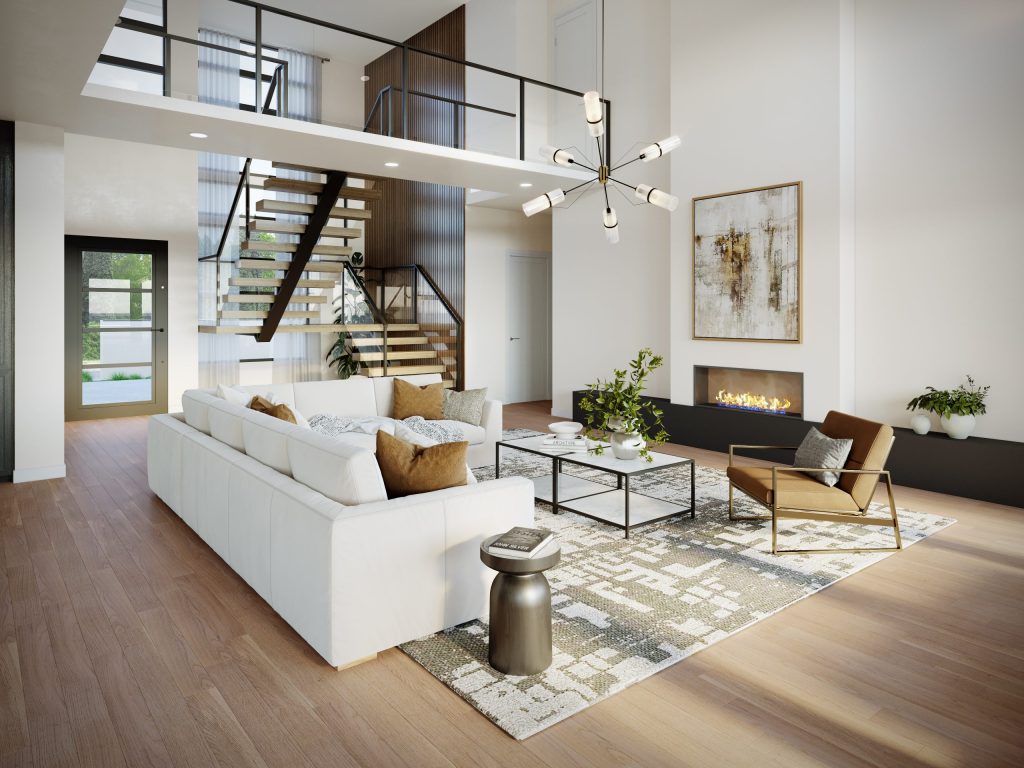
Modern: Focuses on clean lines, strong forms, and minimal ornamentation. Common materials include glass, stone, veneer wood, and matte metals. Color palettes are typically neutral, accented with a few bold color touches.
Contemporary: A flexible style shaped by current trends, often blending modern elements with softer details. Its strength lies in an “airy” layout, balanced proportions, and lighting that adds depth making it adaptable to many floor plans.
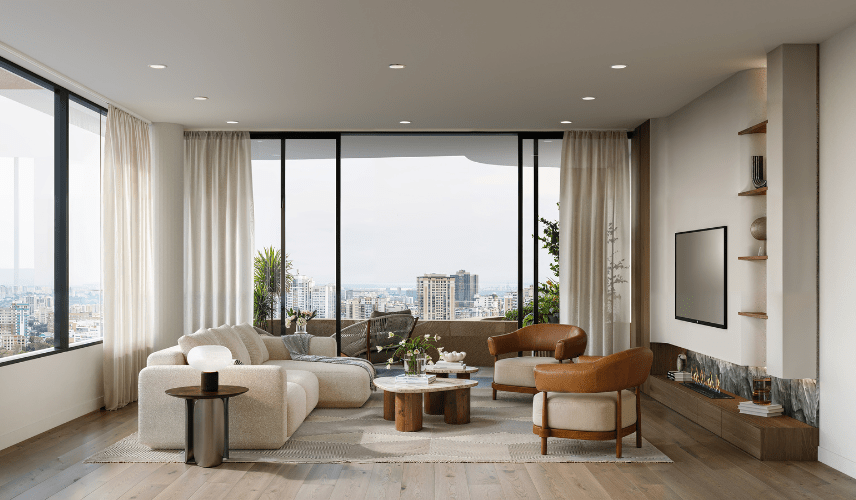
Minimalist: Prioritizes simplicity and negative space. The render must convey “less but better”: fewer objects, fewer colors, fewer details while keeping proportions, materials, and lighting highly accurate so the space still feels refined and intentional.
Scandinavian: Emphasizes warmth, natural textures, and a welcoming atmosphere. Key traits include soft lighting, light-toned wood, woven textiles, rugs, and raw finishes. Neutral tones (white/cream/light gray) are often paired with pastel accents or earthy colors.
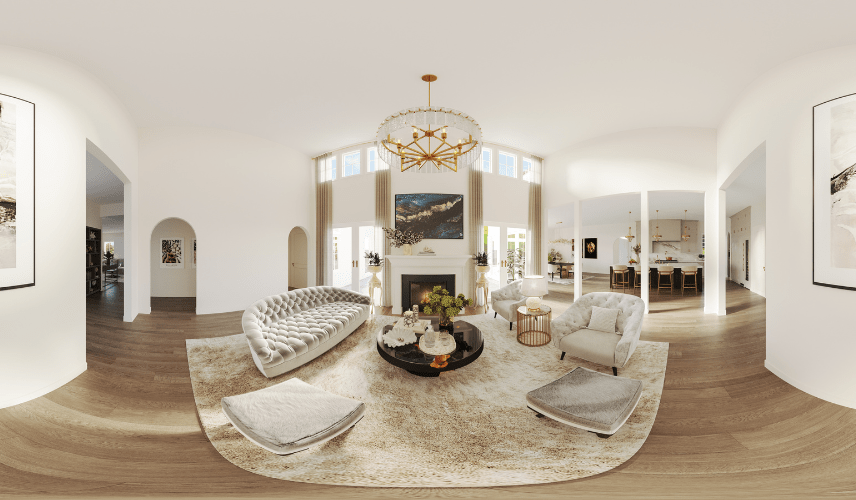
Luxury: Highlights a premium feel through materials and lighting: dramatic-vein stone, metals, glass, leather, dark wood, and a deliberate mix of glossy and matte surfaces. The key is to capture realistic reflections, highlights, and true-to-life finishing details.
Beyond these popular styles, living room design offers many other directions such as Japandi, Industrial, Rustic, and more. Each has its own “language” in layout, materials, color, and lighting. That’s why, when developing Living Room 3D Renderings, it’s crucial to define the target style early, so the final visuals remain consistent, capture the right spirit, and help clients make decisions faster.
Minimalist style living room
Why is Living Room 3D Rendering considered the “heart of the house” in design presentations?
The living room is often seen as the “heart of the house” because it brings together three essentials at once: aesthetics, functionality, and emotion. In concept presentations, it also acts as a “style anchor,” helping clients infer the overall direction for the rest of the interior spaces.
A style anchor for the entire interior
A strong Living Room 3D Rendering allows clients to instantly recognize whether the overall concept feels modern, minimalist, warm, or luxurious. If the client wants to change direction, adjustments at the 3D stage are usually faster and more controllable than making changes once construction has begun.
Communicates the atmosphere of the space
A convincing rendering isn’t just about furniture, it’s about the overall feeling: warm or cool, relaxing, refined, or comfortable. These qualities depend heavily on lighting, contrast, materials, and composition and 3D rendering is the clearest tool to express them.
Clarifies finish materials
From wood, stone, fabric, and metal to wall paint, 3D Rendering helps clients visualize gloss level, texture, undertones, and how surfaces relate to one another reducing the risk of selecting the wrong materials.
Visually compares lighting scenarios
3D Rendering makes it possible to evaluate multiple lighting options (natural light, ambient, accent, and mood lighting) before construction. This is especially important for designs where emotional impact and user experience are top priorities.
Supports feng shui and spatial “flow”
Living Room 3D Rendering helps clients quickly assess openness, sightlines, and circulation within the living room—factors often associated with a sense of comfort, balance, and “good flow.” When layout adjustments are needed to create breathing space or improve pathways, changes at the 3D stage are far easier to control and carry less risk than revising during construction.
Livingroom is heart of the house
How does Living Room 3D Rendering help designers persuade clients?
A truly convincing Living Room 3D Rendering isn’t just about looking “nice”, it needs to be accurate: accurate lighting, materials, proportions, and the overall mood the concept is meant to deliver. Below are the key elements that make a render feel realistic and help clients approve faster.
Improves visualization and reduces misunderstandings: 2D drawings are essential for technical execution, but for clients, 3D provides a complete picture of proportions, functionality, circulation, focal points, and layout. This is especially helpful for detail-heavy designs (custom cabinetry, ceiling systems, cove lighting, and specialized materials).
Speeds up decision-making: Photoreal visuals help clients make informed choices about furniture arrangement, color palettes, and the overall style direction. As a result, concept approval is often faster with fewer revision rounds caused by misinterpretation.
Adds flexibility when presenting options: Designers can showcase multiple options (materials, colors, lighting, décor) in a structured way, enabling clients to compare and choose confidently without slowing down the project timeline.
Supports marketing goals (for real estate projects): For developers, brokers, and marketing teams, Living Room 3D Rendering becomes a key asset for early promotion and sales. High-quality renders allow audiences to feel the future space, increasing interest and engagement.
Saves time and cost later: When the design is clearly visualized upfront, major changes can be resolved during planning reducing the risk of expensive on-site revisions or changes after materials and furniture have already been ordered.
When lighting, materials, composition, and details work together, a Living Room 3D Rendering becomes a reliable “preview” of the final space helping clients visualize faster, decide with confidence, and reduce costly changes later.
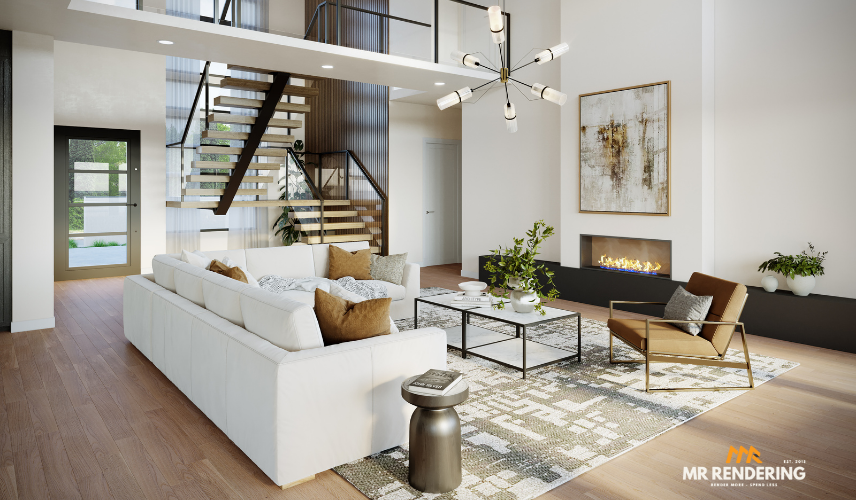
Realism is a key element in Living Room 3D Rendering.
Why MR Rendering is the right partner for Living Room 3D Rendering
When choosing a partner for Living Room 3D Rendering, image quality is only part of the equation. What truly matters is consistency, a smooth collaboration process, and reliable delivery. At MR Rendering, we focus on:
A clear workflow that helps control quality at every milestone (brief → draft → revisions → final).
Consistent visual standards, ideal for projects requiring multiple viewpoints or multiple deliverables within the same package.
Flexible time-zone collaboration, shortening feedback cycles and enabling continuous progress updates.
Project confidentiality, with secure workflows and NDA support available upon request.
Scalable capacity, suitable for projects with multiple spaces, variations, or high-volume output needs.
Conclusion
Living Room 3D Rendering acts as a decision-making lever: when the living room is presented convincingly through accurate lighting, materials, composition, and viewpoints—clients can immediately understand the value of the design. This often leads to faster, clearer concept approvals, fewer misunderstandings, fewer revision rounds, and a smoother execution phase with fewer unexpected changes.
Content Writer, Copy Writer
Thao Nguyen is a content writer specializing in 3D rendering, with a strong focus on translating complex visual and technical concepts into clear, engaging content. Through carefully crafted narratives, Thao highlights the creative value and practical impact of 3D visualization, helping audiences better understand and connect with the work behind each image.