The most important decision in any rendering project is not which studio to hire, it is which type of rendering to order. Choose the wrong format and you end up with a beautiful image that cannot do the job you actually need: close a pre-sale, win a planning approval, or help a client fall in love with a space that does not yet exist.
There are seven main types of 3D architectural rendering in professional use today. Each serves a different purpose, suits a different stage of the project lifecycle, and reaches a different audience. This guide explains what each type is, when to use it, and what it costs, so you can make the right call before the brief goes out.
What Are the Types of 3D Architectural Rendering?
Architectural rendering is the process of generating photorealistic visuals from a 3D model before a building is constructed. What most people call “a render” is actually one of several distinct formats, each with its own production process, output file, and best use case.
According to the State of Architectural Visualization 2024–25 report by Chaos and Architizer – a survey of over 1,000 design professionals across 75 countries still-image renderings remain the most valued client deliverable, while 44% use AI to generate concept images. Understanding which format fits your goals is the first step to getting real return from your CGI investment.
The 7 Main Types of 3D Architectural Rendering
3D Exterior Rendering
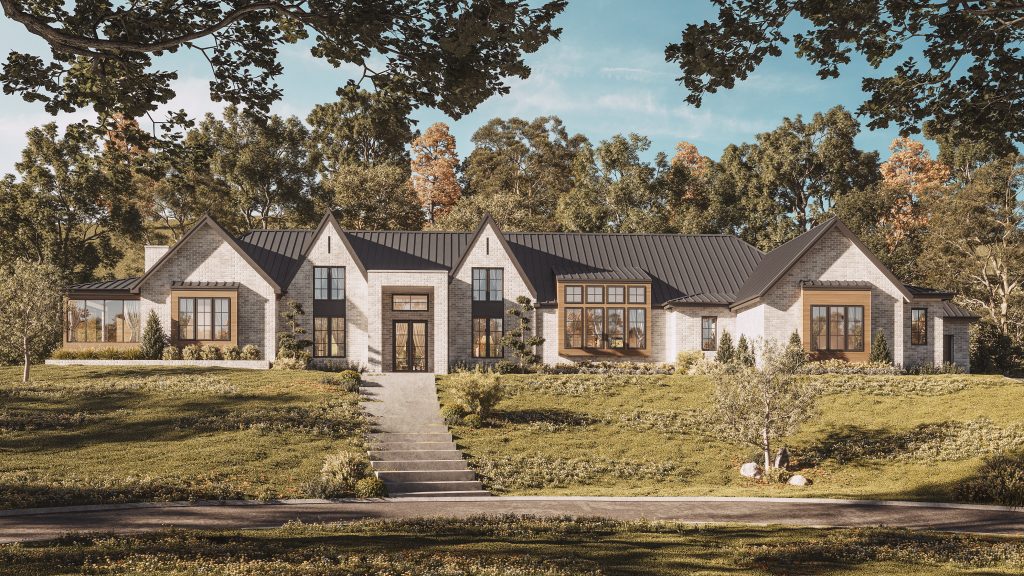
3D exterior rendering is the most widely used format in the industry. It produces a photorealistic still image of the outside of a building — its façade, entrance, landscaping, and surrounding context from a carefully chosen camera angle.
Exterior renders are used across virtually every project type: residential homes, apartments, villas, commercial developments, and townhouses. Lighting choice — daytime, dusk, or golden hour significantly shapes the mood and marketing impact.
Best for: Pre-sales marketing, client presentations, planning applications, developer brochures, listing portals.

3D exterior rendering is the most widely used of all types of 3D architectural rendering showing façade, landscaping, and site context from a chosen camera angle.
3D Interior Rendering
3D interior rendering visualizes the inside of a space furniture layout, material finishes, lighting atmosphere, and the overall feel of a room before it is built or furnished.
This format is indispensable for interior design presentations, CGI interior design approvals, show home marketing, and helping buyers understand how a unit will feel to live in. A well-produced interior render communicates material decisions as clearly as a physical mood board often more so, because it shows everything in context simultaneously.
Common deliverables include living room renders, bedroom renders, and kitchen renders. For projects where the interior is the primary sales asset, 3D rendering for interior design delivers some of the highest ROI of any CGI format.
Best for: Interior design client approvals, show home and display suite marketing, real estate listings, material and finish selection.

3D interior rendering visualizes furniture, finishes, and lighting atmosphere
Architectural Animation & Walkthrough
Architectural animation takes the still render and sets it in motion. A CG animation moves the camera through and around a development exterior approach, lobby, corridors, amenities, and individual units, typically cut into a 60–120 second video with music and motion graphics.
This format is the most powerful storytelling tool in the CGI toolkit. It can present an entire mixed-use development in under two minutes, covering every asset that a static image cannot: spatial flow, scale relationships, the transition from exterior to interior, and the emotional journey of arriving at a building for the first time.
Best for: Developer marketing launches, investor presentations, project websites, planning and community engagement.
3D Virtual Tours
A 3D virtual tour is an interactive CGI experience that lets viewers navigate through an unbuilt space at their own pace clicking or tapping from room to room, controlling their viewpoint, on any device with a browser.
Unlike animation, which is a linear experience the viewer watches, a virtual tour is one the viewer explores. This makes it uniquely effective for remote buyers and international investors. For virtual tours of houses, the format has largely replaced printed brochures as the primary pre-construction sales tool in many markets.
Best for: Remote and international pre-construction sales, property websites, display suite replacements, investor portals.

3D virtual tours let buyers navigate a space at their own pace – one of the most effective rendering types for remote and international real estate sales.
3D Floor Plan Rendering
3D floor plan rendering transforms a flat, technical floor plan into a dimensionally accurate, top-down or isometric visual with furniture, materials, and room proportions clearly shown.
Most buyers find 2D architectural drawings difficult to read. A 3D floor plan solves this by presenting the same spatial information in a format anyone can immediately understand even without an architectural background. This makes it one of the most cost-effective additions to any floor plans for real estate marketing strategy, with a low production cost relative to the uplift it provides in listing engagement and buyer confidence.
3D home floor plans are used extensively in developer brochures, real estate portals, and listing platforms, particularly for apartment and multi-unit projects where buyers are comparing multiple floor plan options side by side.
Best for: Real estate listings, developer brochures and price lists, property portals, planning documentation.

3D floor plan rendering turns flat technical drawings into clear, dimensionally accurate visuals
3D Photomontage Rendering
3D photomontage rendering also referred to as a photomontage in architecture composites a CGI building model into a real photograph of its proposed site. The result shows exactly how a development will appear within its actual context: street, skyline, waterfront, or landscape.
This type occupies a unique functional role: it is frequently a statutory requirement for planning permission applications in the UK, Australia, and many US jurisdictions, where authorities need to assess visual impact before construction begins.
Beyond planning, photomontages are also used in external render marketing for infill and regeneration schemes, any project where the relationship between the new building and its existing surroundings is a primary concern.
Best for: Planning permission applications, council approval documents, urban infill and regeneration marketing, heritage and sensitive site developments.
Building Photomontage – 3D Photomontage Rendering – MR Rendering Studio

3D photomontage composites a CGI building into a real site photo
Aerial Rendering
Aerial rendering, sometimes called bird’s-eye or drone-perspective rendering shows a development from above, capturing its relationship to the surrounding site, street network, landscape, or urban context.
This format is essential for masterplan projects, large-scale residential estates, commercial campuses, and any development where understanding the site layout is as important as understanding the building itself. Multi-family home renderings and commercial rendering projects frequently use aerial views to communicate density, open space provision, and the overall character of a scheme in a single image.
Aerial renders are also used alongside 3D visualization packages for masterplan approvals, community consultations, and infrastructure project communications.
Best for: Masterplan and estate-scale developments, community consultations, planning authority submissions, commercial campus marketing.
7 Types of 3D Architectural Rendering: At a Glance
| Type | Output | Best Stage | Primary Audience | Starting From |
|---|---|---|---|---|
| Exterior Rendering | Still image | Any stage | Buyers, planners, clients | $200 |
| Interior Rendering | Still image | Design & marketing | Buyers, interior clients | $150 |
| Animation | MP4 video | Marketing launch | Investors, buyers, press | $1,500 |
| Virtual Tour | Interactive web | Pre-sales | Remote / int’l buyers | Per scene |
| Floor Plan | Still image / PDF | Sales & listings | Buyers, agents | $100 |
| Photomontage | Composite still | Planning stage | Planners, consultants | $250 |
| Aerial Rendering | Still image | Masterplan stage | Planners, investors | $300 |
How to Choose the Right Type for Your Project
The right format comes down to three variables: project stage, primary audience, and what the visual needs to accomplish.
For pre-construction sales: exterior stills and animation form the foundation adding a virtual tour improves conversion for remote buyers. For planning applications: photomontage is often required; aerial render adds context. For interior design: room-by-room interior renders or a full show suite package are the professional standard.
Most studios including MR Rendering offer full architectural 3D rendering services packages combining stills, animation, and virtual tours from a single 3D model. This is more cost-efficient and ensures visual consistency. Architecture firms scaling output without growing headcount typically rely on outsource 3D rendering services for this reason.
Why Choose MR Rendering for 3D Rendering Services
With over 15 years of experience in architecture and 3D rendering, the team at MR Rendering blends technical precision with artistic vision to help studios, architects, and real estate developers bring their concepts to life through high-end 3D architectural visualization.
High-End Visuals, Optimized Investment
Achieve up to 60% cost savings compared to local studios while receiving premium quality without compromise. Whether the brief calls for a single exterior still, a full suite of interior renders, or a complete package combining animation, virtual tour, and floor plans, MR Rendering delivers studio-grade output at a price point that makes the investment straightforward.
Consistency You Can Rely On
Every image is carefully crafted to align with your brand and meet the highest standards. A streamlined workflow, transparent communication, and continuous feedback under dedicated project leadership ensure dependable results from a single residential still to a full commercial CGI package for a mixed-use development. All projects are handled under NDA, and studios working with MR Rendering as a white-label production partner benefit from a flexible, fully managed outsourcing model.
Scalable Production, Delivered When You Need It
With a team of 30 in-house artists, MR Rendering handles projects of any scale with speed and precision from a single image turnaround in 3 business days to full multi-format packages produced from a single 3D model. The studio serves clients across the US, Australia, UK, and Canada.
Ready to elevate your projects with professional 3D architectural visualization? Browse the portfolio or visit the services page and let MR Rendering bring your vision to life today.

From exterior stills to full CGI packages, MR Rendering delivers all types of 3D architectural rendering with studio-grade quality and up to 60% cost savings
Frequently Asked Questions
What are the main types of 3D architectural rendering?
The seven main types are exterior rendering, interior rendering, architectural animation, 3D virtual tours, floor plan rendering, photomontage rendering, and aerial rendering. Each serves a different communication goal and suits a different stage of the project or sales process.
Which type of rendering is best for selling off-plan properties?
A combination of exterior stills, interior renders, and a walkthrough animation covers the core buyer journey. Adding a 3D virtual tour significantly improves conversion for remote and international buyers who cannot visit a sales office in person.
What is the difference between a 3D render and an architectural animation?
A 3D render is a static image – a single frozen moment in the CGI scene. An architectural animation is a video where the camera moves through the scene. Animations take longer and cost more to produce, but they communicate scale, flow, and design narrative in ways a still image cannot.
What type of rendering is required for planning permission?
Most planning authorities accept photomontage renderings, CGI composited into a real site photograph—as the standard format for assessing visual impact before construction.
How much do the different types of architectural rendering cost?
Floor plan renderings typically start from around $100, exterior stills from approximately $200, interior stills from around $150, and photomontage renderings from about $250. Architectural animations generally start from $1,500 for a 60-second video. Pricing varies depending on project scope, complexity, and quality requirements.
Can different rendering types be combined into one project package?
Yes. Combining multiple rendering formats into a single package is standard practice for marketing-stage projects. A comprehensive CGI package often includes exterior stills, interior visuals, animation, and a virtual tour produced from the same 3D model, ensuring visual consistency and reducing overall production costs.

MR Rendering là một biên tập viên nội dung đầy tâm huyết ,
chuyên về nội dung chất lượng cao tập trung vào dựng hình và hình ảnh kết cấu 3D. Với chuyên môn sâu rộng trong lĩnh vực này, MR Rendering cung cấp thông tin rõ ràng, sáng tạo và truyền cảm hứng, kết nối hiệu quả với khách hàng và các chuyên gia trong ngành.