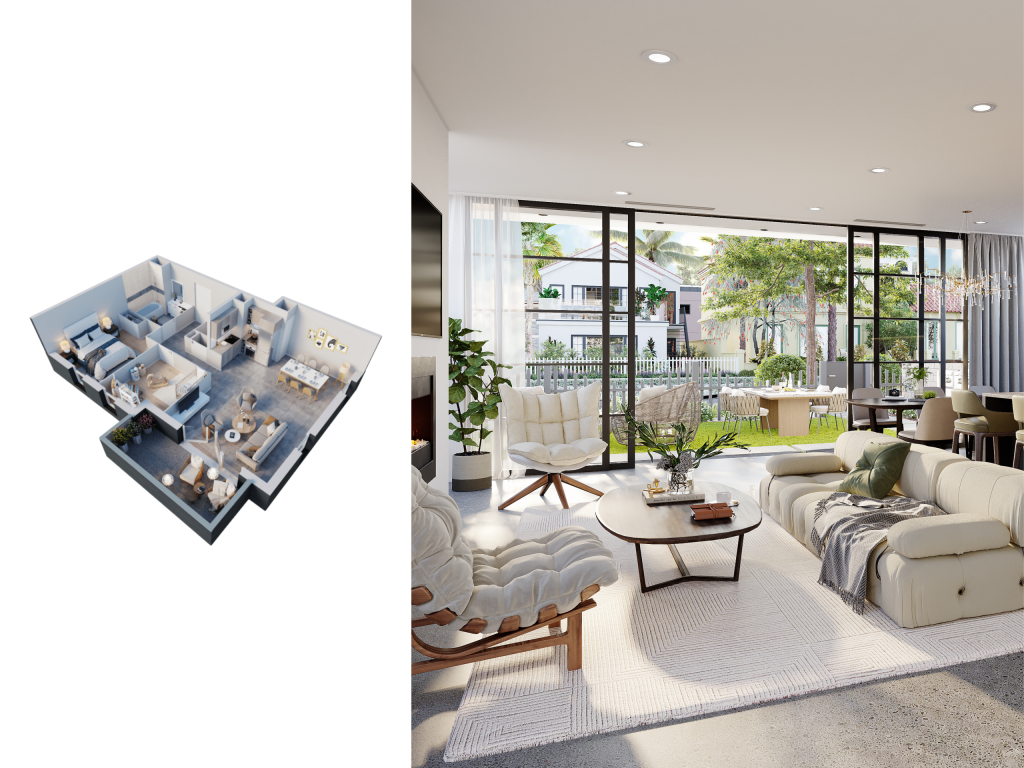
In residential design, 2D drawings remain the industry-standard language for technical documentation and construction coordination. However, when the goal is to persuade clients, finalize a layout, or prepare marketing materials, 2D plans often face a common challenge: non-professionals struggle to visualize space from flat lines and symbols. As a result, even perfectly scaled drawings can still lead to longer approval cycles and late-stage revisions. That’s where 3D rendering house plans serve as a bridge between technical accuracy and real-world experience. In this article, together with MR Rendering Studio, we explore how 3D rendering house plans accelerate project timelines and solve many of the limitations that traditional 2D plans often leave unresolved.
What Are 3D Rendering House Plans?
At its core, a floor plan is a drawing that represents a space in a horizontal cut (a top-down view) to describe how rooms and areas relate to one another on the same level. Building on that foundation, 3D rendering house plans are an “upgraded” presentation format: the layout still follows the floor plan, but it is reconstructed in three dimensions so viewers can better understand scale, depth, furniture placement (if included), and how functional zones connect throughout the home.
While 2D drawings remain essential in every project, from a client or investor perspective they can easily cause confusion especially around depth, furniture proportions, walkway widths, ceiling height perception, or how “open” a room will feel. That’s why the right question isn’t “Is 2D better than 3D?” but rather what the drawing is used for and who it is meant to communicate to. For homeowners, investors, or marketing teams, clarity and immediate understanding are often just as important as technical accuracy.
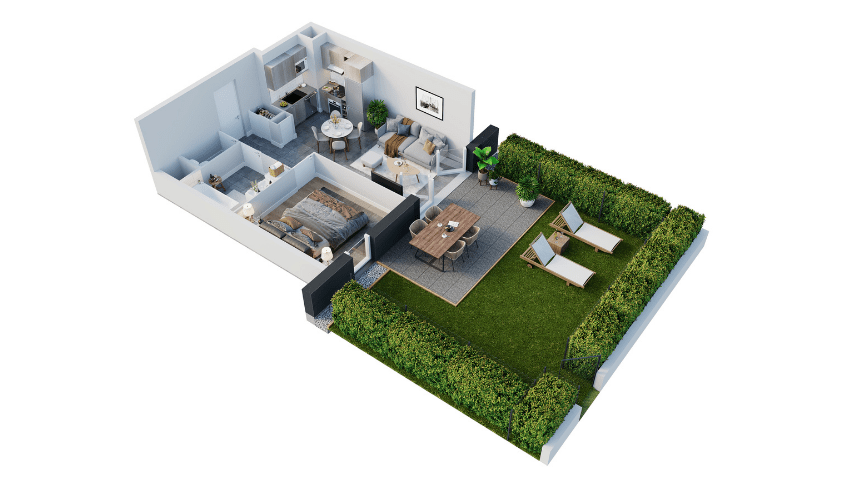
Turn 2D drawings into a clear, realistic layout
8 Outstanding Benefits of 3D Rendering House Plans Compared to 2D House Plans
Visualize the Overall Layout at a Glance
3D rendering house plans allow viewers to grasp the layout through a complete, top-level perspective rather than having to interpret and imagine it. In just a few seconds, clients can understand where each room is located, which areas are intended for shared daily living, which zones are private, and how different spaces connect. For multi-story homes, 3D also makes the relationship between the ground floor and upper floors much easier to see. When the layout is instantly clear from the start, conversations naturally shift away from basic explanations and move toward meaningful optimization.
Compare Options More Easily
With 3D rendering house plans, comparing multiple options becomes significantly faster especially for real estate professionals who often handle several alternatives at the same time. Instead of spending hours or even days driving clients from one property to another, teams can pull up multiple 3D layouts, present them directly on-screen, and explain key differences on the spot.
Thanks to visual clarity, each option can be presented in a way that feels more convincing and easier to engage with. Buyers can quickly recognize differences in layout, circulation, and functionality, helping them narrow down choices and select the best-fit solution sooner. As a result, businesses only need to schedule in-person visits for a shortlist of pre-qualified options rather than touring numerous locations.

3D rendering house plans help you visualize the home before building.
Simplify Presentations with 3D Rendering House Plans
Once completed, 3D rendering house plans can be exported as high-quality images while remaining lightweight and easy to store. This makes them simple to share via email or messaging apps, enabling clients to review and respond quickly without opening complex technical files.
Beyond one-to-one sharing, these 3D visuals are also well suited for publishing on property platforms, partner websites, or third-party listing sites helping you present design options consistently and professionally across channels. During pitches, product showcases, or trade shows, pairing 3D rendering house plans with models and supporting imagery can make presentations clearer, more polished, and far more memorable from the very first viewing.
Monitor and Track Project Progress More Effectively
Creating a strong design concept is only the starting point tracking implementation and ensuring everything stays aligned with the plan is often the harder part. At this stage, 3D rendering house plans can serve as an accessible, visual tracking tool that makes progress updates clearer and more consistent than relying solely on emails or text-based reports.
With only a few steps, developers or project teams can show clients exactly where the project sits on the timeline: which zones are completed, which items are currently in progress, and which components are still pending. Because the information is visual, updates feel more transparent and easier to understand, significantly reducing the risk of misinterpretation during ongoing communication.
Speed Up Collaboration and Shorten Approval Cycles
3D house plans often lead to more actionable feedback. Clients can pinpoint exactly which area needs adjustment and describe their expectations in terms of viewpoint and real-world experience. This creates a positive ripple effect: fewer review rounds, higher-quality input in each round, and faster decision-making overall. For projects involving multiple decision-makers homeowners, family members, investors, or sales/marketing teams 3D plans also reduce repeated explanations, since a clear visual helps everyone align quickly around the same understanding.
Identify Functional Issues and Layout “Friction Points” Earlier
When a design is viewed in 3D, many small but impactful usability issues become easier to notice: hallways that feel too narrow, awkward corners that limit furniture placement, doors that clash when opened, circulation paths cutting through key living areas, stair placement disrupting the flow, or poorly resolved transition spaces. By spotting these issues early, adjustments can be made during layout optimization when changes are still relatively easy and far less likely to trigger larger downstream impacts.
Support Better Furniture Decisions and Real-Life Function Planning
3D rendering house plans act like a practical “test version” of the home, allowing teams and clients to validate furniture placement and day-to-day functionality. It becomes easier to see which areas need clear circulation, whether furniture sizes are proportionate, whether spacing feels comfortable, and whether the overall arrangement balances aesthetics with usability. This is especially valuable in spaces where layout decisions are often challenging: living rooms, kitchen–dining zones, master bedrooms, and home office areas. When furniture and functional priorities are confirmed earlier, the next steps style direction, materials, lighting, and detailing tend to move forward more smoothly and consistently.
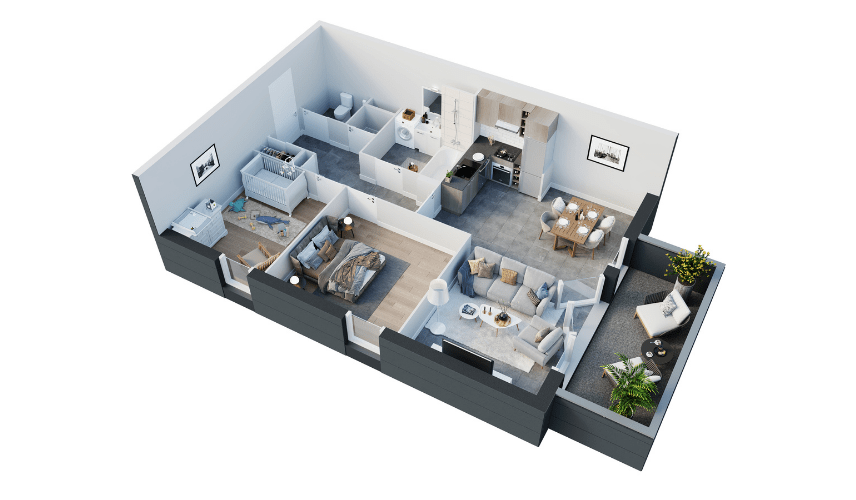
Speed up approvals with clearer presentations.
Improve Project Presentation and Increase Marketing Persuasion
3D house plans are highly effective for brochures, proposals, listings, landing pages, and investor presentations. They help audiences understand the value of the layout even without technical knowledge, increasing trust and engagement. For presales or off-plan projects, 3D plans also reduce the barrier of “I can’t picture what the home will look like,” enabling sales teams to explain layouts faster and helping buyers feel more confident in their decisions.
| Read more about how 3D rendering of house plans can shorten the time it takes to sell a property
When Should You Use 3D Rendering House Plans and When Are 2D Plans Enough?
2D plans are typically used when:
- You need technical / construction documentation: dimensions, symbols, elevations, and detailed measurements.
- The project is in a coordination phase (architecture–structure–MEP) where precise parameters must be controlled.
You should use 3D rendering house plans when:
- You need to finalize the layout quickly (layout freeze) and validate functionality and circulation.
- You’re presenting to homeowners, investors, or non-technical clients who need to understand the plan immediately.
- The project involves multiple decision-makers and you want to reduce vague feedback loops and shorten approval time.
- You’re preparing sales / presales materials, where buyers need to visualize the layout with minimal effort.
If your priority is technical documentation, measurement accuracy, and construction coordination, 2D is essential. But when the project hits decision points that demand speed finalizing the floor plan, aligning on functional zoning, presenting to homeowners/investors, or preparing sales materials 3D rendering house plans deliver clear, practical value.
In practice, many teams follow a layered approach: they begin with 2D to establish technical correctness, then add 3D house plans to lock in the layout and reduce review rounds. Only after that do they invest in photoreal renders (exterior/interior) for “hero” views used in marketing.
Conclusion
In short, 3D rendering house plans are a smart “finalization” step that helps projects move faster and with more confidence. The layout becomes clear from the beginning, feedback turns more specific, approvals become smoother, and late-stage revisions are minimized. When combined strategically with 2D drawings and photoreal marketing renders, you get a consistent workflow for presentation, decision-making, and execution from concept to sales.
If you’d like to turn your 2D floor plans into clear, accurately scaled, and highly persuasive 3D rendering house plans, MR Rendering is ready to support you with a transparent workflow and consistent visual standards across every project. Share your plans and desired outputs, and we’ll recommend the right number of views to help you finalize faster and present more professionally.
| Learn more about 3D house plan rendering services at MR Rendering.

Content Writer, Copy Writer
Thao Nguyen is a content writer specializing in 3D rendering, with a strong focus on translating complex visual and technical concepts into clear, engaging content. Through carefully crafted narratives, Thao highlights the creative value and practical impact of 3D visualization, helping audiences better understand and connect with the work behind each image.